




(A homeowner’s guide to understanding the infrastructure behind your community)
If you live in a Colorado community with a metro district, you may have opened your property tax bill and wondered:
“What exactly am I paying for?”
It’s one of the most common questions residents ask—and it’s a fair one. Property taxes can feel abstract until you connect them to the things you see every day in your neighborhood.
Metro districts exist to finance, build and maintain many of those things from scratch. From roads and sidewalks to parks and water systems, metro districts finance and operate essential public infrastructure that allows communities to exist, function, grow, and thrive.
Let’s take a closer look at where those dollars go.
Before a home can be built in a new neighborhood, an enormous amount of infrastructure must already be in place.
These are things most of us rarely think about—but rely on constantly:
Constructing this infrastructure costs millions of dollars. Metro districts provide a financing mechanism that allows many of these improvements to be built upfront so communities can grow affordably and responsibly – and residents can enjoy immediately.
Instead of requiring a homebuyer to pay tens of thousands of dollars in public infrastructure costs at closing, metro districts spread those costs out over time through property taxes.
Think of it like a community mortgage for public infrastructure.

One of the most visible investments metro districts make is transportation infrastructure.
This includes:
These features are essential for safety, accessibility and mobility within a community.
In many new neighborhoods, metro districts build these improvements in coordination with the local municipality for long-term integration into the broader regional transportation network.
Beneath the surface of every neighborhood is a network of infrastructure that residents rarely see but rely on every day.
Metro districts often finance the construction of:
These systems protect homes, prevent flooding, and ensure clean and reliable water service for residents.
Because they must be installed in the land before homes are built, metro districts finance them through low-interest, tax-exempt municipal bonds and repay those costs overtime.
Many Colorado communities pride themselves on access to parks, trails, and open space. Metro districts frequently play a major role in building and maintaining those amenities.
Examples include:
These improvements help create the character of a neighborhood and provide gathering spaces for residents.
Maintaining them—mowing grass, trimming trees, repairing playgrounds, and maintaining irrigation systems—is often funded through the operations and maintenance portion of a metro district budget.
In Colorado, winter maintenance is no small task.
In some communities, metro districts take on these services rather than an HOA:
· Snow removal from neighborhood roads and sidewalks
· Ice management
· Street sweeping
· Landscaping upkeep
· Irrigation system maintenance
· Community facility maintenance
These day-to-day services keep neighborhoods safe, clean, and functional year-round.
When you see snowplows clearing neighborhood streets or landscaping crews maintaining parks, that work is often funded through metro district operations.
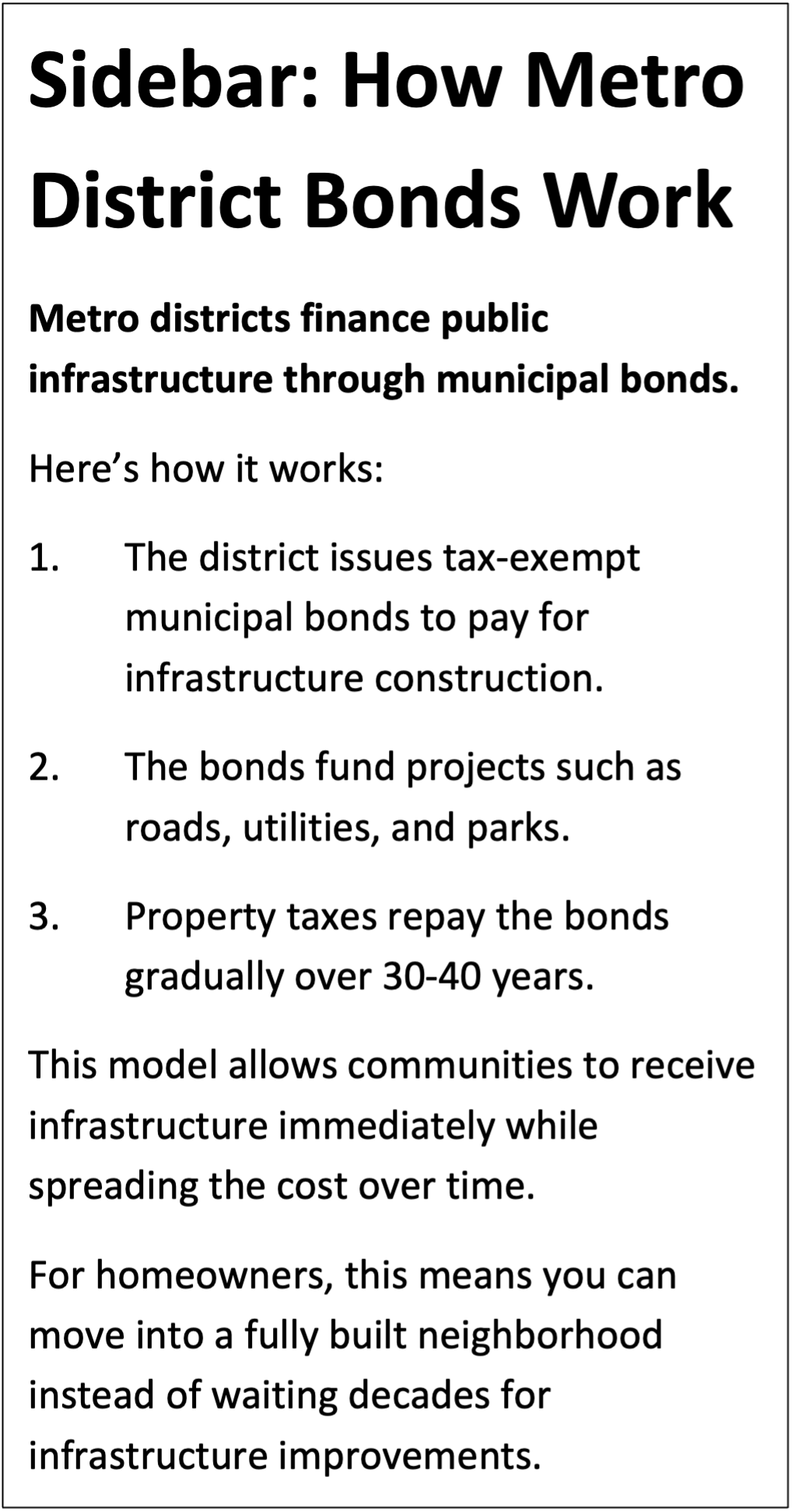
The primary component of metro district funding comes from municipal bonds that are repaid over time.
When a new community is built, metro districts issue municipal bonds to finance the upfront cost of much of the public infrastructure.
These bonds are low interest, tax-exempt and repaid over time through the property taxes of the property owners in the district, instead of ultimately being paid up front at closing for families.
For residents, this means that you enjoy roads, water and sewer, and utilities from day one, and that you pay gradually overtime for those necessities.
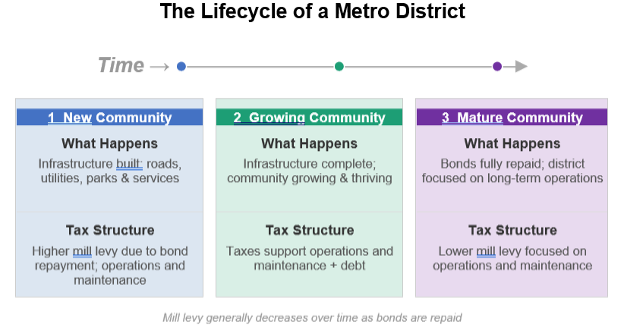
As bonds are repaid, the tax burden tied to that public infrastructure will decrease.
For example, the Highlands Ranch Metro District retired its bond debt in 2021, leaving only operations and maintenance costs today.
This illustrates how metro districts evolve as communities mature.
Colorado uses metro districts as a tool to ensure that new growth pays for itself.
Without metro districts, cities and counties would have limited options:
Metro districts provide a more flexible solution by allowing public infrastructure to be financed over time by the people who benefit from it.
One important thing to remember is that property taxes largely stay in the local community.
Your property tax bill funds services like:
These dollars support the systems and services that make communities livable and connected.
It’s easy to see a property tax bill as just another expense.
But when you break it down, it’s really a snapshot of how a community works.
Those numbers represent the roads you drive on, the parks your family plays in, and the water and sewer systems that serve your home. Metro districts help build and maintain many of these essential features.
So, the next time you open that envelope from the county treasurer, you’ll know exactly what you’re contributing to: the public infrastructure and services that make your community possible and the amenities your family enjoys.
The Metro District Education Coalition provides resources to help residents better understand how metro districts operate.
Visit our Knowledge Center for:
Because informed residents make stronger communities.