



How to Read Your Colorado Property Tax Bill: Cracking the Code on Those Mysterious Lines
Hey there, fellow Colorado homeowner. You just pulled that official-looking envelope from your mailbox – the one from the county treasurer – and your eyes glaze over at all the numbers, acronyms, and line items. “What even is a Metro District?”
Those days of confusion are over. The Metro District Education Coalition is here to decode it for you in plain English. In fact, you’ll find that the tax bill is actually a useful snapshot of how our community works and how local services are funded – call it a community’s group receipt for schools, roads, parks, fire protection, and all the local services that make Colorado life awesome.
Our goal here is to provide you with some guidance, so at the end of this short message, you’ll feel confident reading your bill, understand exactly where your money goes, and see metro districts as the smart community-funding tool they really are.
What Exactly Is a Property Tax Bill?
The bill comes from the county treasurer and covers taxes for the previous year; it’s mailed at the end of January. The first half of our property taxes was due February 28th and the second half is due June 15th. Coloradans have two options for payment, they can make two equal payments on February 28th and June 15th or pay the amount in full on April 30th. All the money stays right here in our city and county—no state government slice.
The bill is built on two big pieces of information from the county assessor:
· Actual Value: The assessor’s best estimate of what our home would sell for on the open market as of January1. This estimate is reassessed every two years for real estate, in odd-numbered years.
· Assessed Value: This is not the full actual value, thank goodness. The state sets an assessment rate, a percentage, to calculate the taxable portion. The legislature determines this number and typically sets it once a year.
For residential properties in 2025 (paid in 2026), the assessed value is 6.25% for local governments and 7.05% for schools. Rates can shift slightly each year based on state law, so it is always best to double-check your county’s latest numbers.
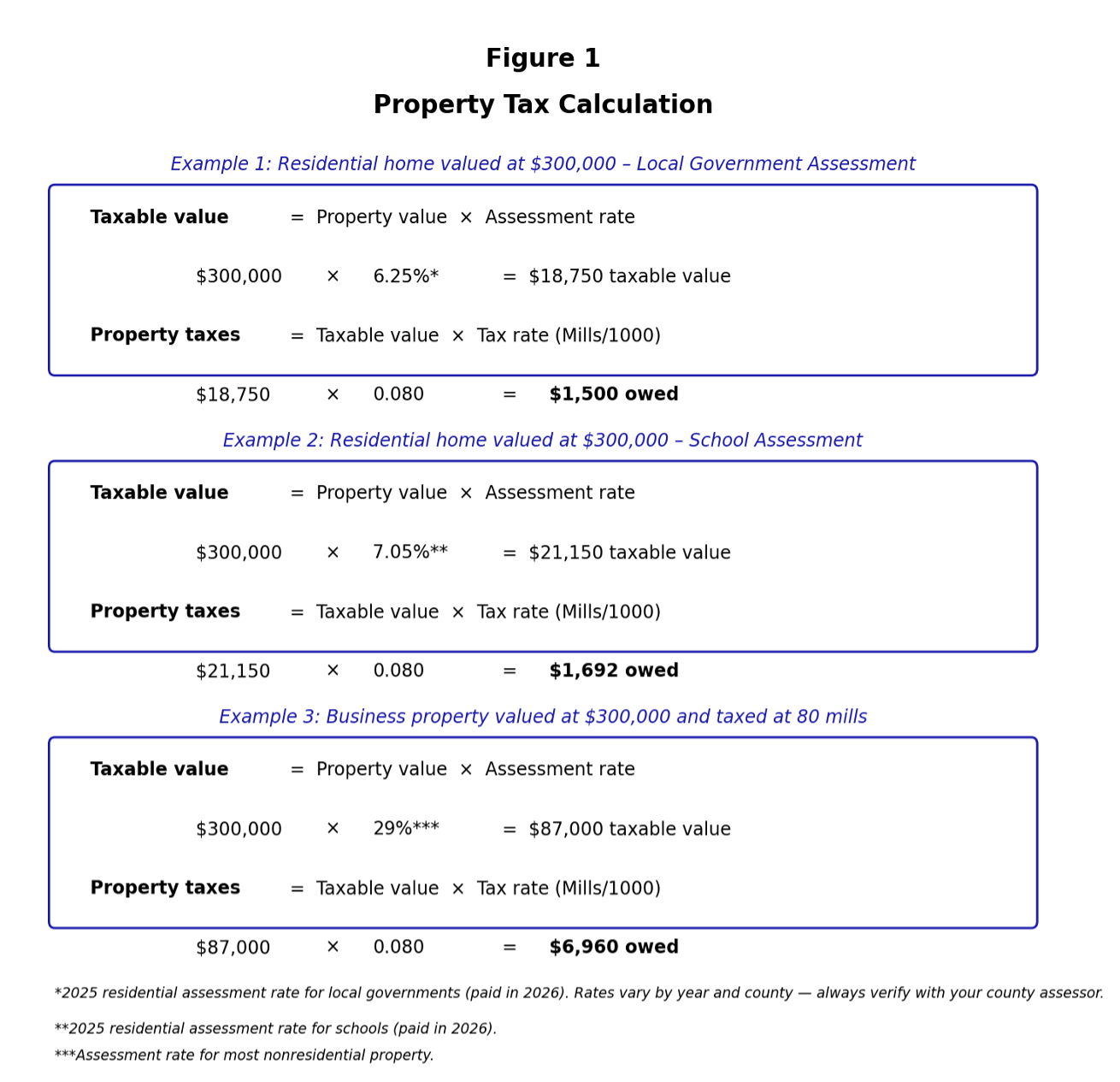
Figure 1 is a simple real-world example adapted from the Common Sense Institute of Colorado, using a $300,000actual value home:
· Local government assessed value: $300,000 × 6.25% = $18,750
· School assessed value: $300,000 × 7.05% = $21,150[KP1]
Then each gets multiplied by the local taxing jurisdiction’s mill levy (more on that next).
Understanding Mill Levies: The “$1 per $1,000” Secret
A mill levy (or just “mill”) is the tax rate. One mill = $1 of tax per $1,000 of your assessed value. Your total mill levy is the sum of rates from every local government that serves your property: county, city/town, school district, fire district, library, and—yes—any metro or special districts.
Example breakdown (common in Colorado):
· County: ~10–15mills
· Schools: ~40–60mills
· City + other locals: ~10–20 mills
· Metro/special districts: 50-75 mills
The simple calculation formula is as follows: Assessed Value × (Total Mill Levy /1,000) = Your Tax. Therefore, if your assessed value is $18,750, like the above chart, and the total mills are 80, you owe $1,500.
The Metro District Spotlight: What Those Extra Lines Actually Fund
If your bill has lines for a metropolitan district, especially common in brand-new communities, don’t panic – we got you. Metro districts are local governmental entities created to keep the costs of street, sewer, parks, and other public infrastructure in communities across the state lower. Cities and counties use the financing tool frequently as a fair and equitable way to build public infrastructure in residential and commercial communities…only the property owners within the boundaries of the district pay for the public infrastructure, and the costs are spread out over time, similar to a mortgage.
The district finances the streets and parks by issuing low-interest, tax-exempt municipal bonds. You and your neighbors repay those bonds over 30-35 years through property taxes instead of paying for 100% of the public infrastructure costs upfront when you purchase your home. This way, you receive all the community benefits up front and pay just a little each year over time.
On your bill, you’ll see just one line item for your metro district. This number is a cumulative number that includes:
· Operations: Day-to-day stuff such as watering parks, landscaping, and administrative costs for the district.
· Debt Service: Paying back the bonds for all that infrastructure.
Here's an example from Timnath Ranch in Larimar County —
The Timnath Ranch Metro District’s 2026 approved budget shows an Operating and Maintenance mill levy of 5.118 mills and a debt service mill levy of 39.983, for a total metro district mill levy of 45.101 mills.
In concrete dollar terms, for a $500,000 home in Timnath Ranch, the metro district portion of the tax bill comes to $1,409.41/year. At the community's median home value of ~$537,500, the average homeowner pays roughly $1,515.11/year to the metro district.
By contrast, the Highlands Ranch Metro District retired its bond debt early in 2021, and it only has its Operations and Maintenance mill levy, which is 12.250 for the 2026 budget year that will show on property tax statements. The Highlands Ranch community was developed in the 1980s–90s, and is serviced by the Highlands Ranch Metro District. Since the bonds are now paid off, what remains is the cost of maintaining and operating a beautiful community — not servicing bond debt.
Timnath Ranch, being a newer development, is still in the debt-repayment phase — hence the 45.101-mill levy. That's the core tradeoff: you get a brand-new neighborhood with shiny infrastructure, but you're the one paying down the bonds that built it, typically over 35-40 years.
Figure 2. What this contrast illustrates:
Timnath Ranch (Larimer Co.) Highlands Ranch (Douglas Co.)
Metro District Mill Levy 2026 ~45.101 mills ~12.250 mills
District tax on ~$500k home ~$1,409.41 ~$382.81
Bond status Actively repaying Paid off (2021)
Community age Newer (~2010s+) Established (1980s–90s)
Highlands Ranch is essentially what Timnath Ranch becomes in 20–30 years— a mature community where the debt is retired and the levy drops. Weuse this as an example that the financing tool works, and taxes do go down.
How to Check the Numbers Yourself
Cool stuff so far, eh? Here’s how to verify everything:
1. Your Assessed Value: Log into your county assessor’s website. Search “[Your County] CO assessor property search.”
2. Mill Levies & Districts: Use the free Property Tax Map | Colorado Department of Local Affairs Division of Property Taxation. Just plug in your address. This will show you every taxing district and last year’s rates.
3. Budgets: Every taxing entity, including metro districts, must make budgets publicly available. To find your metro district, go to your metro district’s website or check the Colorado Department of Local Affairs website at https://dola.colorado.gov/dlg_lgis_ui_pu/. Transparency is the law!
4. Estimate Your Bill: Colorado’s Department of Local Affairs (DOLA) provides a tax map tool that even has a calculator.
The Department of Local Affairs (DOLA) serves as the primary interface between the state and local communities. DOLA provides financial support to local communities and professional and technical services to community leaders in the areas of governance, housing, and property tax administration. Find tax-specific information on DOLA’s Division of Property Taxation page.
Your Bill = A Snapshot of How Your Community Works
At first glance, that property tax bill looks like ancient hieroglyphics. Now, we hope you more clearly see the pieces – actual value, assessed value, mill levies, and those metro district lines. This is how we all chip in for schools that educate our kids, roads we drive on, parks we picnic in, and the new public infrastructure in growing neighborhoods.
Metro districts aren’t a surprise fee – they are a deliberate tool so new Colorado communities can grow responsibly without burdening everyone else. Your taxes fund the most local services that stay local.
Next time that envelope arrives, open it with confidence. You’ve got this! And if something still looks off, reach out to your county assessor, treasurer, or metro district manager – they are there to help. Also, please reach out to our team at the Metro District Education Coalition anytime if you have questions or would like to learn more. We have a knowledge center, a toolkit, news and events, and much more.
Your home, your community, your tax bill – now fully decoded. Welcome to the informed-homeowner club. 🏡